Paytm DevRev
Working session · DevRev × Paytm · Service Desk Automation

Every internal request.
One AI service desk.

Computer on Paytm’s own data — IT, People, Finance and Legal operations, one shared brain.

Computer The AI that works your way
Working session
July 2026 · Paytm office
Who’s in the room

Four of us. One goal — show you what’s possible.

Neeraj Matiyani
Neeraj Matiyani
Head of India GTM
Building DevRev India from the ground up — 25+ yrs taking category-defining tech to market. Led AWS Digital Natives, India; took Dell storage from nowhere to No. 3 in India; 13 yrs at HP, rising to Country Manager.
India GTMex-AWSex-Dell
Subodh Nair
Subodh Nair
Account Executive · Regional Leader, North
Owns the Paytm partnership end to end — from the first workspace to 1,800 licenses across five business units, with a dedicated success, support and applied-AI team behind him.
AccountNorth region
Shahabaj Sheikh
Shahabaj Sheikh
Solution Architect
Built IndiGo’s most successful AI agent — autonomous across 4 enterprise systems, 90%+ adoption. 14 yrs of automation — RPA to ML to agents — incl. a $4.2M/yr optimizer.
Solutions Engineeringex-Deloitteex-Sabre
Venkatesh
Venkatesh
Solutions Engineer
Designs and builds working agents on customer data — turning internal service-desk journeys into automations that hold up in production.
Solutions EngineeringJoining virtually
DevRev — founded by Dheeraj Pandey & Manoj Agarwal · 1,000+ enterprise customers · already live inside Paytm’s support operation. Working session · not a pitch
The next 60 minutes

A working session, not a slideshow.

1
The platform
~10 min
How Computer is built — the context layer and knowledge graph that make answers trustworthy inside an enterprise.
Framing
2
Internal ops at Paytm
~5 min
Four service desks, one loop — IT, People, Finance, Legal. Where this lands in your world.
Framing
3
SDA agents, live
~15 min · Venkatesh
Service desk automation end to end — a request lands, an agent works it, it closes.
Live demo · virtual
4
Computer, live
~20 min · Shahabaj
On Paytm’s own data. Ask in plain language, watch dashboards and insights build themselves.
Live demo
5
Where this goes
~10 min · together
Pick the towers and use cases worth building first — we scope it with you.
Discussion
One honest note. Everything you’ll see runs on your data. Treat it as a sketch of what’s possible — breadth today, hardening comes with a scoped build.
The platform · before the demo

Requests in. Answers out. Actions taken.

Computer unifies the systems behind all four Ops towers into one permission-aware shared memory, reasons over it, and acts back — the same loop you’re about to see live.

YOUR TOWER SYSTEMS, FLOWING IN ITOps · ITSMtickets, incidents & access PeopleOps · HRMSpolicies, payroll & onboarding FinanceOps · ERPreimbursements & approvals LegalOps · documentscontracts, NDAs & compliance + warehouse, comms & 50+ connectors (2-way) COMPUTER · THE CORE Computer AirSync 2-way sync Memory knowledge graph NL-to-SQL precise answers Permission-aware context assembled before the AI thinks ACTIONS · AGENTS & APPS ◢ EMPLOYEE-FACING Self-serve service deskchat & portal — answer or resolve GenUI insightsdashboards built per question ◢ FOR YOUR OPS TEAMS Agentic workflowstriage, route, draft, close — with guardrails Agent Studio — build your owncustom agents, no code, in minutes
Built-in across every layer Governance · RBAC & permission inheritance Observability · real-time, every layer Auditability · full trail on every action
Token optimization · same model, same question Memory does the work, so the LLM doesn't
Other AI · fetches all data 3.2M
Computer · sends only the signal 157K
Memory filters & joins in SQL before the LLM ever sees the data — 95% fewer tokens, 5.5× faster, and the gap widens as your data scales.
Context intelligence

Trillions of tokens. Agents need thousands.

Every enterprise sits on trillions of tokens. AI agents work best with thousands. DevRev’s Memory bridges this 6-order-of-magnitude gap.


DevRev’s Memory
Three retrieval layers select just the right tokens — 10–100× fewer than naive RAG. Permission-aware, deterministic where it counts.
 
 
10–100×fewer tokens 100%permission-aware 3 layersin concert
▸ Click to walk each retrieval layer →
ENTERPRISE DATA Trillions of tokens CRM · Tickets · Docs · Emails · Code · Wikis · Logs
TEXT2SQL Structured queries → exact facts “142 open P0 tickets” · “Q4 volume by desk”
VECTOR SEARCH Semantic matching → relevant passages “Refund policy clause” · “Similar incidents”
REVERSE INDEX Keyword lookup → precise terms “TKT-4821” · “E-5012”
AGENT CONTEXT Thousands of tokens Precise · permission-aware · actionable
Knowledge graph

How the Knowledge Graph actually looks.

Stock objects link to custom objects and back — then every relationship traverses as one connected graph.
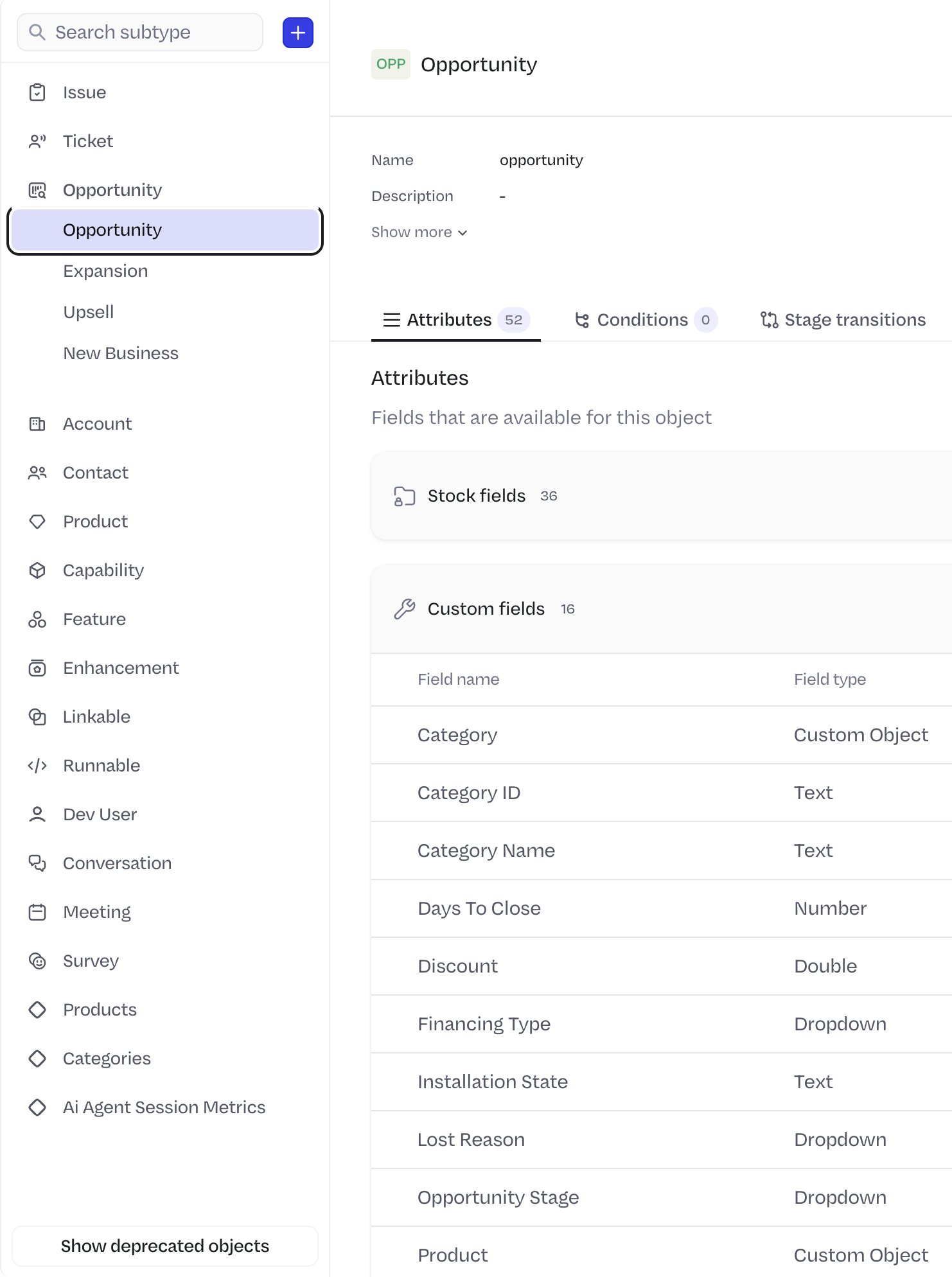
Knowledge Graph schema
Teams Groups Brands Dev User Roles Ticket Issue Conversation Sessions Opportunity Incident Logs Alerts Product Capability Feature Enhancement Articles Account Contact Meeting Survey Runnable Linkable C-Categories C-Products + Custom Object
Traversal
The context graph problem

More context is not better context.

Most agentic platforms pile data into context windows. The larger the context, the higher the hallucination rate. DevRev inverts this with a dynamic Knowledge Graph — a real-time context engine.

The KG Advantage

DevRev's Knowledge Graph synthesizes real-time data across structured and unstructured sources - enabling dimensional clustering, temporal event clustering, and enhanced similarity analysis.

↑ 3.4×
hallucination in RAG
~93%
token efficiency
Internal ops at Paytm

Four desks. One loop. One number.

ITOps“VPN won’t connect”
PeopleOps“Change my payroll bank”
FinanceOps“Reimbursement stuck”
LegalOps“Review this MSA”
Same loop Request Triage Resolve Learn
Every request lands here and splits two ways
Agent closes it no human in the loop
Agent assists context ready, reply drafted
Lever 01 · Autonomy — access, password, policy, status Lever 02 · Assist — the hard cases, a fraction of the time
Resolution
rate
+ Handling
time
= the number that moves P&L
Support metrics are a P&L line in disguise. We size it on your own ticket data, desk by desk.
DevRevSDAruns the desks
Computermakes every human on them faster
● PERMISSION-AWARE VECTORS

Watch how permission-aware retrieval answers each person differently.

DevRev doesn't just bring your data - it brings the permissions with it.

When AirSync ingests a source, it doesn't just copy the records - it captures each source's permissions and embeds them into every vector. So access rules travel with the data, instead of being stripped away like most vector stores do.

The result: one assistant for everyone, yet each person only ever sees what they're allowed to - enforced at retrieval, with no extra config.

See how it works
OneDrive · Unstructured
HR_Policy.pdf
🔒 HR only · 50 pages
Salesforce · Structured
Opportunity #4821
🔒 Sales + Finance · field-level
Two kinds of data arrive from your tools. Each already carries its own access rules.
Permission Engine
ACL extraction + token embedding
🔑
ACL
🧬
token
The engine reads each source's permissions and fuses them into the vector itself - not stored off to the side.
Vector Database UNSTRUCTURED
embedding · chunk_01🔒 HR
embedding · chunk_02🔒 HR
… +14 chunks, permission per vector🔒 HR
Document DB · MongoDB STRUCTURED
record · Opportunity #4821🔒 Sales+Fin
Auth Policy → roles + ACEs🔒 ACE
Docs become permissioned embeddings; records keep their access controls - different stores, same rules.
See how it works Skip
Paytm DevRev
● Permission-aware retrieval · live

One identical question. Two people. Two different answers.

HR ManagerAccess · HR only
Her token unlocks the HR policy but not the Salesforce deal — retrieval returns the bonus answer and silently drops #4821.
Q3 prep
Sales RepAccess · Sales + Finance
Word-for-word the same prompt — his token unlocks deal #4821 and hides the HR policy. Same vectors, different answer.
Q3 prep
Click to continue →
What we’ll show you next

Three flows. Two act. One listens.

Already built Run end-to-end on our own SDA org — working flows, not a storyboard.
01 ITOps · access Tested
Software access,
granted on policy
Asks “I need the analytics tool.”
Policy· 1 tap· Granted
0 Never queuedAccess live in minutes, approval attached
02 ITOps · assets Tested
Asset replacement,
decided not debated
Asks “Laptop won’t hold charge.”
Warranty· Policy· Dispatched
1 One decisionNo thread chasing three teams
03 Coexist · your ITSM Tested
Insight from the tool
you already run
Asks “What eats my team’s week?”
Synced· Asked· Ranked
Nothing switched offThe incumbent runs; the agent learns from it
Up next Venkatesh runs all three live as SDA agents then Computer on the humans who work the desk
Computer · what it can do on your data

Ask in plain English. On 5.6 million tickets.

One agent, both books
OCL5.64Mtickets PPSL164Kmerchant tickets
Switch orgs live — same questions
Computer Live
on your
own data
Ask anything on this data
Nothing pre-loaded. We can start asking now.
01 · Analyticsseconds Millions of rows, no SQL Volume, trend, split, forecast — asked like a colleague, answered before the meeting moves on.
04 · KnowledgeSOPs Reads your policy, not the web Risk SOPs, TAT matrices, loan scenarios — grounded in your documents, cited back to them.
02 · Discoveryno taxonomy Themes nobody labelled It reads the raw text and names the long tail — the repeat work hiding under “Other”.
05 · Conversationfollow-ups “Now break that one down” It holds the thread. No re-stating the question — you drill in the way you would with an analyst.
49% 03 · Trustunprompted Tells you what it can’t know It flagged that half your tickets carry no category — before we asked. Answers come with their limits attached.
Tickets5.6M
Issues137K
KnowledgeSOPs
06 · Reachone agent Every object, one question Support, engineering and knowledge in a single ask — no swivelling between tools.
Now, live Nothing on this slide was built for today — no custom code, no prepared queries. Pick any of these and we’ll ask it on your data, in front of you.
Computer in action - Your AI Teammate
app.devrev.ai · Computer · Ask your pipeline
Full context Connect your CRM, email & calendar, then ask a tough pipeline question - Computer reasons across your org's live data via native Shared Memory.
app.devrev.ai · Computer · Multiplayer
Multiplayer Invite your AE, SE & manager into one session - same deck, same context. Just @Computer for precise answers. One team, harder to beat.
How you’ll know it worked

Every request ends one of three ways. We count the first.

The three endings — every ticket, every desk The one number To baseline it, we need — three things from you
The scorecard
Of every 100 requests
end in 01
Autonomous
resolution rate
One definition, counted the same way every month, per desk.
Every 03 that becomes an 01 is the win
What stays in 02 closes faster each month
No number invented today.
The baseline is deliverable one.
Agent Ending 01the number Agent closed it. Alone. Employee asks, agent answers, ticket closes. No human ever saw it.
AgentHuman Ending 02 A human closed it, faster Context gathered, reply drafted, actions ready. The human just decides.
Human Ending 03 Fully manual, as today The agent couldn’t help. This is the list we work down next.
We need 01 90 days of tickets Any format, any tool. Enough history to see the repeat work.
We need 02 Which desks go first One or two to start — not all four on day one.
We need 03 Today’s handling time Whatever you already track. That becomes the line we beat.
Why it’s blank Any number we put in that box today would be ours, not yours. We compute it from your ticket history, desk by desk — then agree the target together.
To align on

Pick the first tower.
We’ll build it on your data.

Everything you saw today runs on the platform already inside Paytm. The next step is a conversation, not a contract — which tower, which use case, what would make it real for your teams.

1 · Choose the use cases One per tower · start with ITOps — to explore together
2 · A working build on your data Weeks, not quarters — to explore together
3 · Review, then scope the rest Real baselines, tower by tower — to explore together
Computer by DevRev Working session · July 2026
Annexure · Platform architecture

Computer Architecture

Your data, flowing in & out
Bring your app sessions, conversations, opportunities, support tickets, engineering issues, product design, documents, and FAQs - all into DevRev.
Product
Notion Google Docs Figma Datadog Amplitude
Engineering
Confluence Jira GitHub Dynatrace PagerDuty
Sales
ZoomInfo Salesforce Calendly Granola HubSpot
Support
WhatsApp Exotel Zendesk Freshdesk ServiceNow
Finance & Ops
SAP Snowflake Google Drive SharePoint NetSuite
IT &HR
G Suite Okta Workday JumpCloud Freshservice
CDC Pipeline every add & modify aggregate Ponos publish Camel INDEXESindexed from the graph ·powers RAG & answers REACT & WRITEtriggers & writesback to the graph provides nodes 3rd party nodes & operations
Workflow Engine
Deterministic Probabilistic
Runs safely, in isolation

Every workflow step runs on AWS Lambda - an isolated, serverless function that's sandboxed and time-boxed. If a step hangs or errors, it fails out on its own without touching the core platform - so custom logic can never degrade the shared service.

Marketplace
Connectors MCP
Extend without rebuilding

Add capabilities from the Marketplace - connectors sync data in via AirSync, and MCP lets agents call live external tools. Install what you need, public or private to your org - no core changes.
Apps · Customer facing
Chat Widget
Customer Portal
Voice AI
Apps · Internal Teams
Support
Build
Grow
Computer Desktop
Data Warehouse
BigQueryBigQuery
Why timestamped snapshots?

Every add or update to the Knowledge Graph - from AirSync or your apps - is captured as a point-in-time snapshot. Stacking these over time turns the graph into a time-series history, so you can query trends, deltas & "what changed when" - not just today's state.

Summarization Jobs
GCSGCS export
Why summarize?

Scheduled jobs roll up the raw snapshots into pre-aggregated summary tables - counts, trends & rollups per metric. Instead of scanning millions of rows live, the AI reads a compact, ready-made summary - so time-series questions answer in milliseconds, not minutes.

Time-Series Analytics
DuckDBDuckDB · Edge
Why run it locally?

The summaries are small, so charts and reports are built right where you view them - no trip to a far-off database and back. That's why dashboards & 360° views open instantly, with no waiting and no extra cost, even across millions of records.


Knowledge Graph · the core
Permission-aware context, assembled before the AI thinks
AirSync · Memory · NL-to-SQL
Governed · Observable · Auditable
Wherever your team works
Gmail
Outlook
Calendar
Slack
Teams
Zoom
Session360
Customer360
Product360
Developer360
SRE360
+ Custom Dashboards
50+ connectors · AirSync (2-way)
Computer

Introducing Computer.

by DevRev

The only AI with native Shared Memory - so it truly understands your business: your data, how your team works, and how to move it forward. Connect your tools, then watch it reason across your live data.
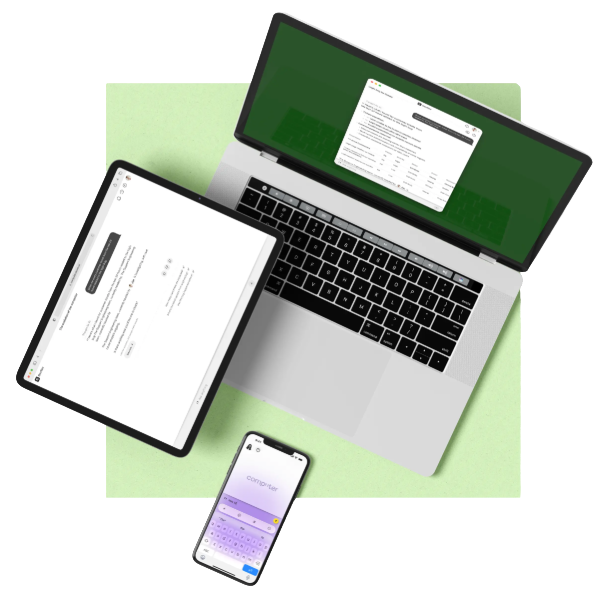
See it in action
Computer in action - Your AI Teammate
app.devrev.ai · Computer · Ask your pipeline
Full context Connect your CRM, email & calendar, then ask a tough pipeline question - Computer reasons across your org's live data via native Shared Memory.
app.devrev.ai · Computer · Multiplayer
Multiplayer Invite your AE, SE & manager into one session - same deck, same context. Just @Computer for precise answers. One team, harder to beat.
Computer across desktop, mobile & web

Wherever you work,
Computer works.

Across the desktop and mobile apps, plus the web version, Computer is there for you wherever, whenever. Chats, memory, and full context stay in sync.
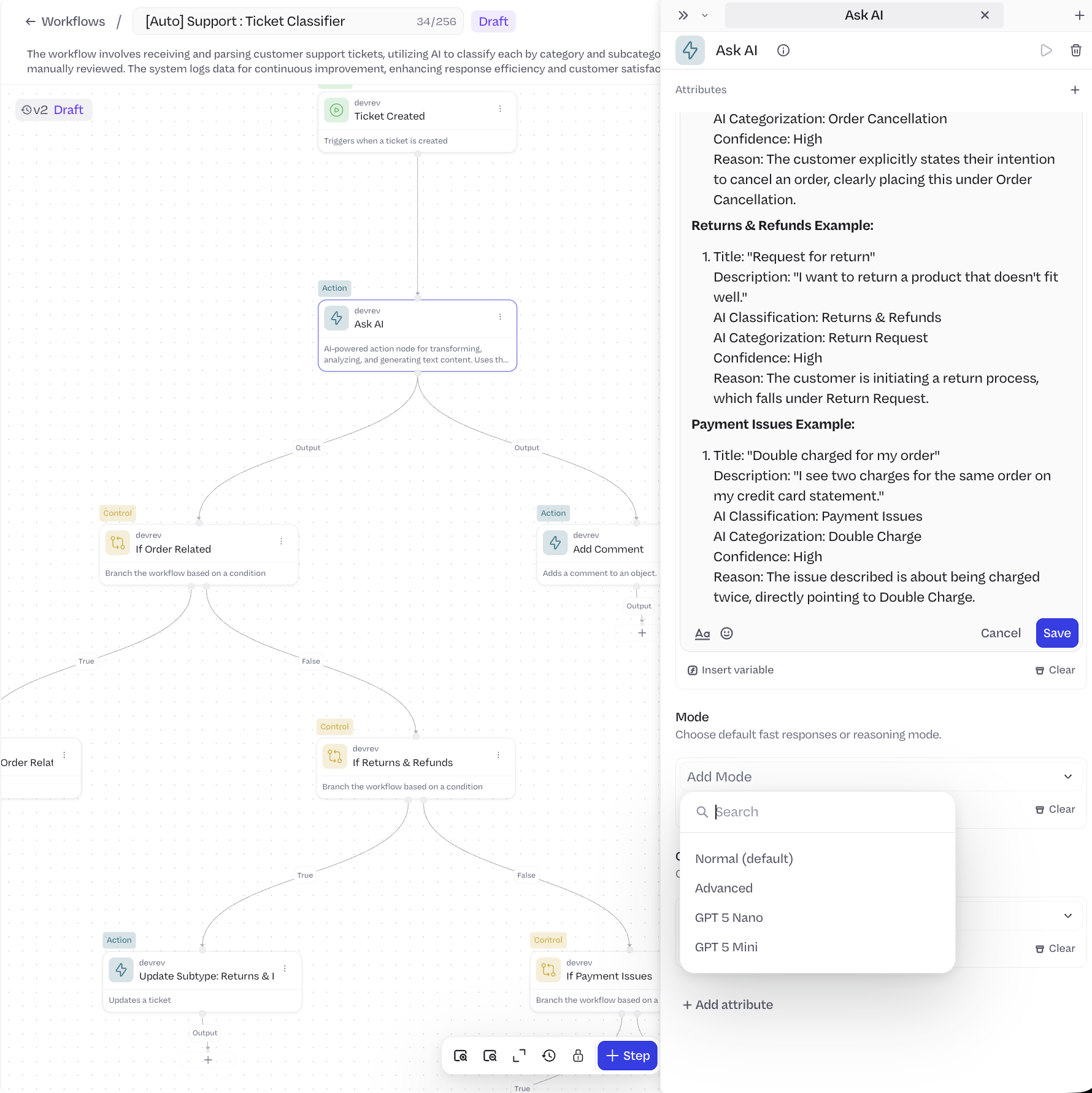
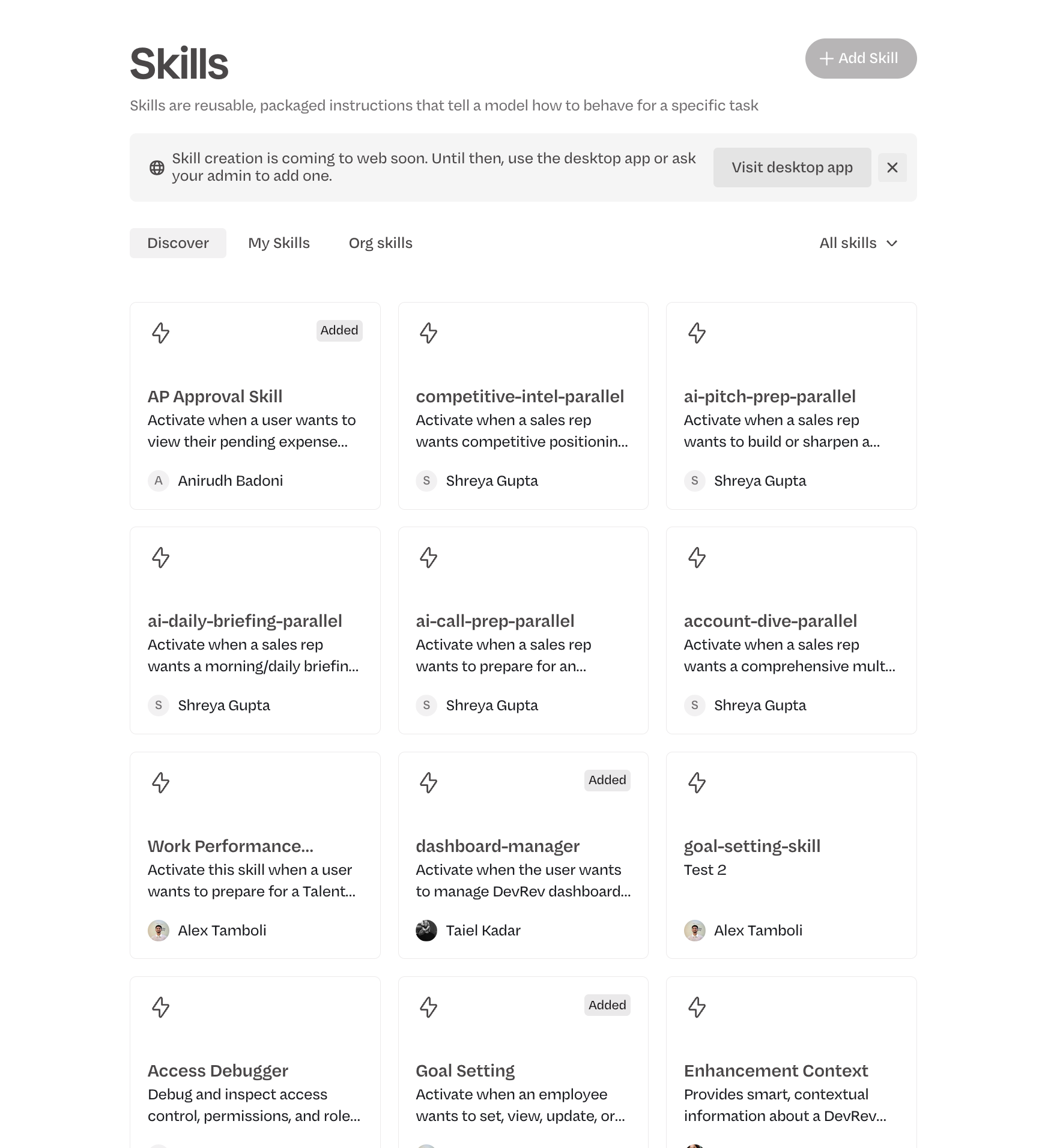
Workflow Engine - 3 Layers
Same workflow, progressively abstracted for different personas.
1
Snap-In Code
Workflow as code package
import { OperationContext, OperationIfc, OperationOutput, Error_Type, ExecuteOperationInput } from "@devrev/typescript-sdk/dist/snap-ins"; import logger from "../common/utils/logger"; import checkPropertyValue from "../common/utils/check_property"; import fetch from 'node-fetch'; async function parsePayload(payload: string) { try { return JSON.parse(payload); } catch (parseError) { // Try cleaning the payload if initial parse fails const cleanPayload = payload.replace(/^/, '').trim(); return JSON.parse(cleanPayload); } } async function makeApiCall(url: string, method: string, payloadObj: any, authorization: string) { if (method === 'GET') { const response = await fetch(url, { method: 'GET', headers: { 'Content-Type': 'application/json', 'Authorization': authorization || '', }, }); return response.json(); } else { const response = await fetch(url, { method: method || 'POST', headers: { 'Content-Type': 'application/json', 'Authorization': authorization || '', }, body: JSON.stringify(payloadObj), }); return response.json(); } } export class APICall implements OperationIfc { public event: any; constructor(event: any) { this.event = event; } async run(metadata: OperationContext, input: ExecuteOperationInput, resources: Record<string, any>): Promise<OperationOutput> { const data = input.data as Record<string, any>; if (data === undefined) { logger.error(`received undefined data in APICall`); return { error: { type: Error_Type.InvalidRequest, message: `received undefined data in APICall` }, output: undefined, port_outputs: [], }; } const url = data['url']; // Check if method is provided and is one of GET, POST, PUT, DELETE. If not, set it to POST. const method = data['method']; let authorization = data['authorization']; const payload = data['payload']; if (!url) { return { error: { type: Error_Type.InvalidRequest, message: 'URL is required' }, output: undefined, port_outputs: [], }; } // Check if authorization is empty and URL contains devrev. If so, use the access token from the metadata. if ((!authorization || authorization === '') && url.toLowerCase().includes('devrev')) { authorization = metadata.secrets.access_token; } try { // Fix payload handling logic let payloadObj = {}; if (payload && payload !== '') { payloadObj = await parsePayload(payload); } const responseData = await makeApiCall(url, method, payloadObj, authorization); return { error: undefined, output: { values: [{ response: responseData }], }, port_outputs: [], }; } catch (error) { logger.error(`API call failed with error: ${error}`); return { error: { type: Error_Type.InvalidRequest, message: error instanceof Error ? error.message : `API call failed with error: ${error}` }, output: undefined, port_outputs: [], }; } } GetContext(): OperationContext { logger.info(JSON.stringify(this.event)); const auth = checkPropertyValue(this.event, 'context.secrets.access_token'); const devorg = checkPropertyValue(this.event, 'context.dev_oid'); const devrevEndpoint = checkPropertyValue(this.event, 'execution_metadata.devrev_endpoint'); const inputPortName = checkPropertyValue(this.event, 'payload.input_port_name'); return { devrev_endpoint: devrevEndpoint.value, secrets: { access_token: auth.value, }, dev_oid: devorg.value, input_port: inputPortName.value, } } }
Ship a workflow as a versioned code package - full TypeScript SDK, source control & CI. Maximum power for engineers who want custom logic and integrations.
2
Drag & Drop
Visual node builder
Visual workflow builder - trigger, routing agent, condition & actions
Build the same workflow visually - drag nodes for triggers, conditions & actions. No code, so ops & support teams can automate on their own.
3
AI Agent Skill
Workflow as agent capability
AI agent skill - workflow exposed as an agent capability
Expose the workflow as an agent skill - the AI calls it in plain language, so any teammate triggers it just by asking. Automation becomes conversational.
app.devrev.ai · Agent Studio
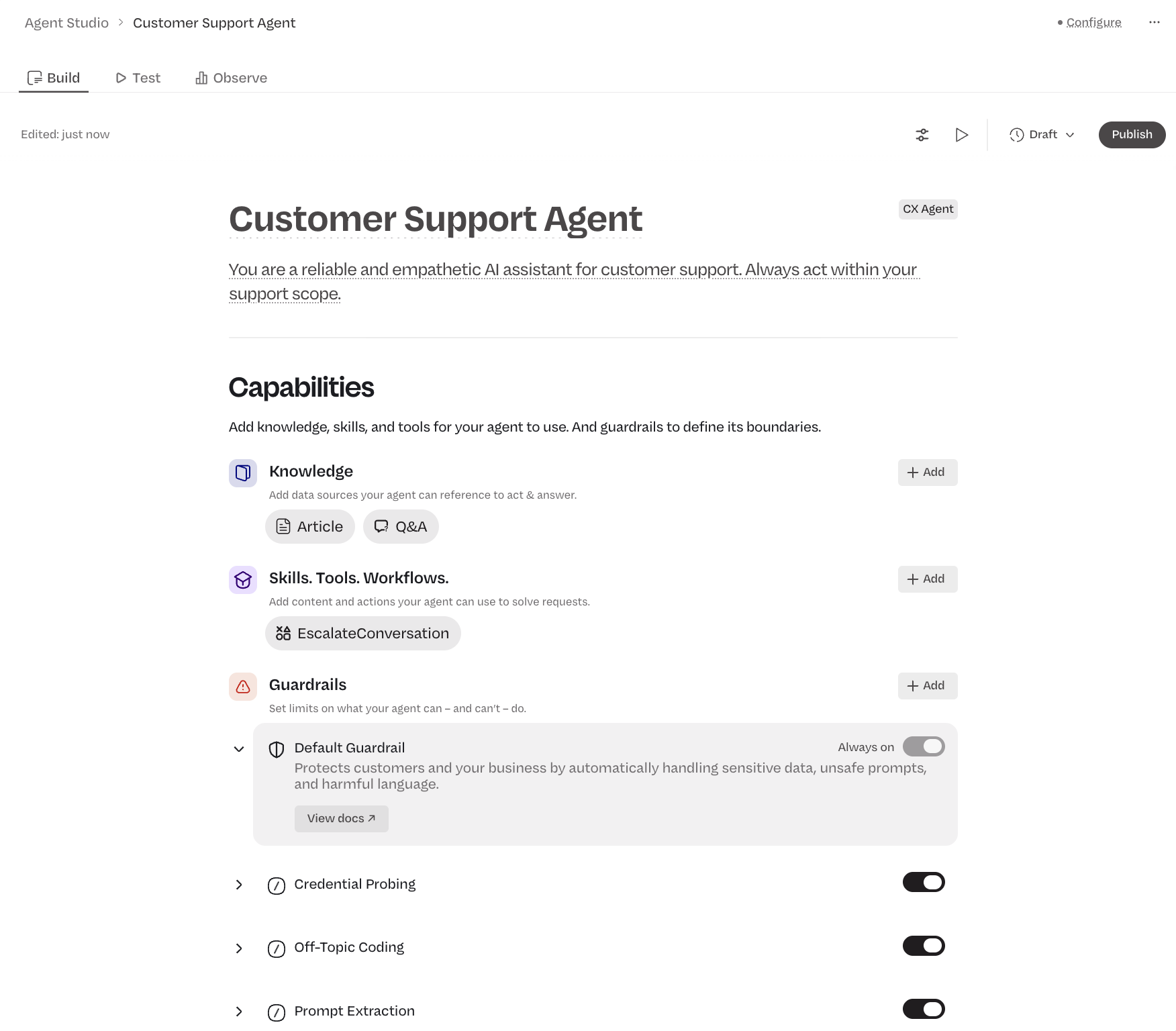
Agent Studio

Agent Studio
From idea to agent, in minutes.

Agent Studio turns these workflow layers into build agents that take action - skills in plain language, code optional. Already connected to Salesforce, Gmail, Slack & GitHub via MCP & native integrations.

Test in a sandbox against real data, deploy across email, Slack & WhatsApp, and keep a human in the loop when it matters - with automatic versioning, full audit logs & guardrails. Enterprise control, start-up agility.
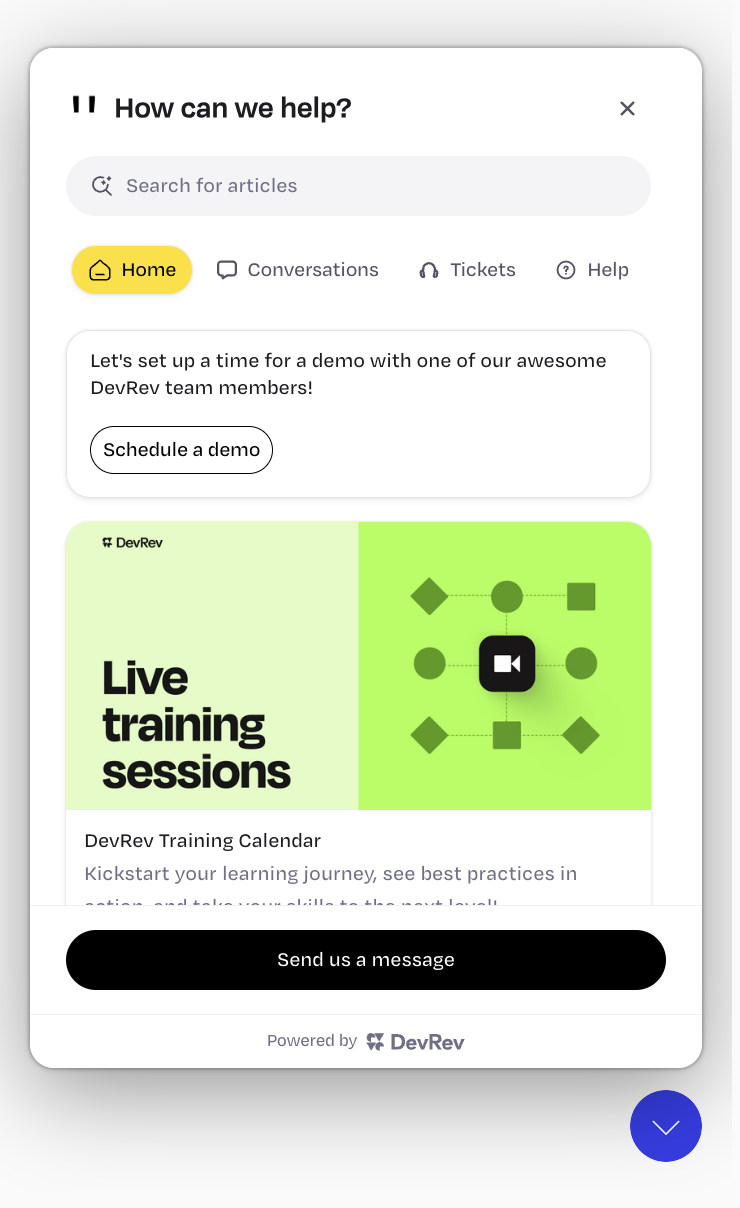
Customer-facing apps
Drop-in surfaces your customers use - all powered by the same graph & agents.
Chat Widget
Chat Widget
In-product chat - customers ask in plain language and the agent answers from your live graph, right inside your app.
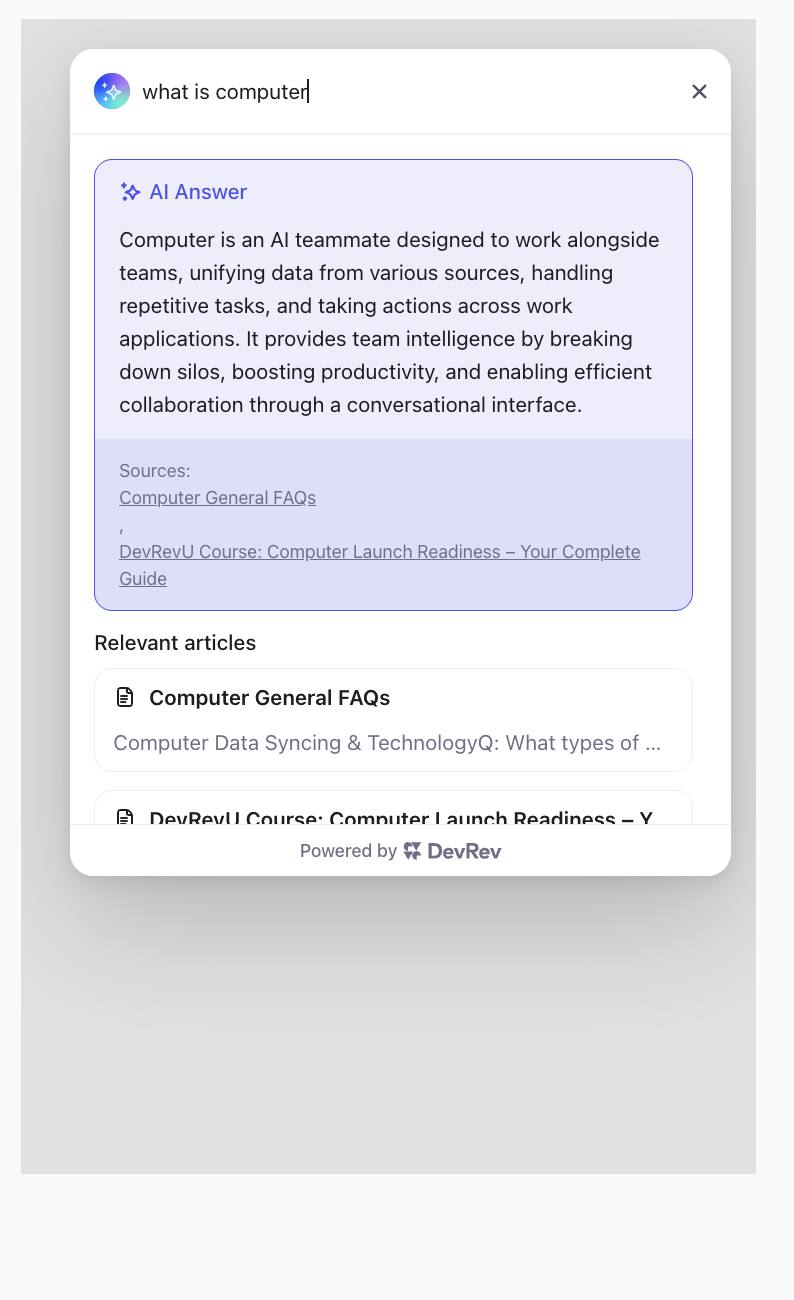
Search Bar
Search Bar
Instant answers - a drop-in search box that returns synthesized answers, not just links, across all your knowledge.
Session Replay
app.devrev.ai · Session Replay
See what happened - replay the customer's real session so support & product understand the issue in full context.
Every customer surface, enterprise-ready out of the box
Chat, search, portal, session replay & voice all share the same engine - so these capabilities come built-in, not bolted on per app.
Multilingual PLuG AI-native conversational bot engages users naturally across global languages - on product, web & mobile.
Multi-brand Run multiple brands & business units on one platform - dedicated portal/PLuG instances, per-brand workflows, branding & analytics, with a shared KB tagged per brand.
True omnichannel Email, Slack, WhatsApp, voice (Amazon Connect) & web - unified in one workspace, with any custom channel added via snap-ins.
Permission-aware Every answer respects the customer's identity & entitlements - surfaced from the same governed graph.
AI deflection Auto-resolves 50–60% of repetitive issues via LLM knowledge retrieval - before a ticket is ever created.
Smart escalation Unresolved chats hand off to a human agent with full context retained - and real-time deflection/escalation insights.
One platform. One architecture.
Every surface you just saw - apps, search, workflows, the marketplace and agents - runs on the same Knowledge Graph. Connect once, and it all compounds.
One Knowledge Graph Apps, search, analytics & agents all read and write the same governed system of record - no silos, no copies.
Connect once AirSync brings every tool in; MCP & the marketplace extend it. New data & capabilities light up everywhere instantly.
It compounds Every interaction enriches the graph - so search sharpens, agents get smarter, and the whole platform improves over time.
01